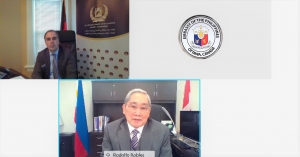
Ottawa- October 9, 2020

 Ambassador Hassan Soroosh met virtually this afternoon with H.E. Saoud bin Abdullah Zaid Al-Mohmoud, Ambassador of the State of Qatar to Canada. The two sides discussed various areas of bilateral cooperation; the recent state visit by H.E. President Ashraf Ghani to Qatar, and the ongoing peace talks in Doha.

 
Ambassador Soroosh expressed his appreciation for Qatar’s continued support to peace and development in Afghanistan.

Ottawa- October 8, 2020


Ambassador Hassan Soroosh had a virtual meeting this morning with the Honorable David Morrison, Foreign and Defence Policy Advisor to the Prime Minister of Canada. The two sides discussed a wide range of issues pertaining to bilateral cooperation, the Afghan peace process, COVID-19 situation and the preparations for the Geneva Conference on Afghanistan.
 
Ambassador Soroosh expressed his appreciation for Canada’s continued commitment and principled position in support of Afghanistan and the Afghan peace process.
 
Mr. Sayed Mujtaba Ahmadi, Deputy Chief of Mission also attended this virtual meeting.

Ottawa- October 6, 2020

On October 04, 2020, a gathering of Afghan-Canadian social, cultural and religious organizations based in British Columbia was held to discuss the Afghan peace process.
 
In their final statement, the participants highlighted their demands including a call for an immediate and permanent cease-fire in Afghanistan; protection of human rights of all Afghan citizens including ethnic and religious minorities, women, and children; preservation of the Afghanistan National Defense and Security Forces; the importance of international support and the effective implementation of a peace agreement.
 
Photos by the Afghan Canadian Association of British Columbia

Ottawa- October 6, 2020

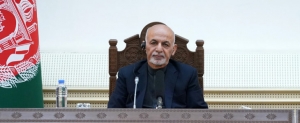
Bismillah-e-rahman-e-rahim,

Honorable Co-chairs: Minister Arghandiwal, Special Envoy Taalas,

Ambassador Lyons, Honorable Cabinet Ministers, Representatives of our International Partners, the Diplomatic Community, and Multilateral Development Organizations, My fellow Afghan Citizens, Ladies and Gentlemen:

It is a pleasure to interact with you once again here at the launch of the Afghanistan 2020 conference coming up next month.

Before proceeding, I’d like to send my best wishes to President Trump for a quick recovery. We sympathize and empathize with all of our international partners who are now confronting the second wave of COVID-19. We in Afghanistan have been fortunate that the first wave passed with relatively low casualties, but we are now preparing for all eventualities in case of another wave.

I’m sorry that I cannot be with you in person today. Afghanistan is a country of many pressing priorities, but peace will always remain at the forefront. Thus I am on a state visit to Qatar today to move the peace process forward.

The process of preparing for the conference and collaborating on the draft of the ANPDF II has provided us, as partners, an opportunity to have a comprehensive and detailed discussion on Afghanistan’s past, present, and future development trajectory. Together, we have been breaking new ground in approaching the Conference as a process rather than an event, thanks to Special Envoy Taalas and all of you. The constructive conversation will be continuous, focusing on policy and implementation until and after the Conference.  You thoughtful comments on the draft ANPDF II, consolidated in two cross-cutting and sectoral categories, are greatly appreciated and we will take them into account and act on them.

Let me thank the government of Finland, the UN, and all of our partners for agreeing to hold the conference on November 23 and 24 in Geneva and for agreeing to announce your commitments. We look forward to it.

Today, I would like to respond to some of the key points you made in your feedback.

We share with you a vision of a sovereign, unified, democratic Afghanistan at peace with itself, the region and the world, capable of preserving and expanding the gains of the past two decades.

This is not just the ultimate objective of our negotiations with the Taliban in Doha, but more importantly, it is also the ultimate goal of the work we do every day within the halls of government to meet our development objectives. 

In Doha, our negotiation team is working on making peace, but here, back in Kabul, we—as a polity, an economy society, and a people—along with you, our international partners, are working on building peace.

Peace-building is different from peace-making because it is a multi-dimensional, cross-sectoral, short, medium and long-term process that will allow us to actually implement and secure the components of any peace agreement that is made on paper.

In other words, peace-building is about implementation; peace-making is about reaching a political agreement to end violence. We must now focus on prioritizing these components of peace-building and implementing them. The ANDPF II is all about peace-building—it is a document that shows us how to peace-build in the context of today’s Afghanistan.

In developing the vision laid out in the ANPDF II, we had to take into account not only the context of today’s Afghanistan, but also, what we have learned from our success, failures and shortcomings over the past five years.

First, turmoil, the dominant context of our existence, has led to a near-constant state of uncertainty and risk.   But, as we respond quickly to natural disasters, or pandemics, or political crises, we must not lose sight of medium to long-term development goals.  We have to think further ahead.

Second, dealing with intended or unintended changes, policies and priorities in the development agenda has meant constant adjustment and reprioritization.  To enhance the impact of our joint work, we must avoid operating in silos both within the government and with and among efforts by partners, civil society organizations and the private sector.

Third, imperatives of political inclusion entail costs for effective governance, leadership and management.  Benefits and costs of political participation require joint analysis and mutual understanding.

Fourth, despite the decades old global consensus on the need for institution- building, our reliance on parallel organizations and third-party governance structures continues. Alignment between development theory and practice, particularly on tailoring of implementation arrangements to context, will require more thorough discussion among us.

Fifth, it has been difficult to achieve alignment between functions and levels of governance, particularly between ministries and sub-national levels, has been a challenge.  Misallocation of resources has been a significant challenge in this regard.

Overall, we need to work hard to more clearly articulate and own the goals of ownership, leadership, mutual accountability and self-reliance.   

Peace-building goes hand in hand with two other pillars that are outlined in the ANPDF II— market-building and state-building.

Credibility of the state and stability of the Republic, as articulated in our Constitution, depends on earning the people’s trust. Building an effective state starts with listening to our people and understanding their expectations.  I have really tried to do this over the past years, with over 95 trips to the provinces and meetings with thousands of Afghans from all walks of life.

The generous level of assistance in the last 19 years raised up the level of expectations, beyond our national resources. To both deliver and manage the expectations of our people, we must fully embrace the objective of self-reliance by focusing on how to convert our latent assets and capabilities into manifest resources and capacities. We must do more with less by embracing effectiveness, efficiency and transparency.  We must learn to master the art of leadership and management under conditions of constant change. At the same time, we as a state must deliver services to our people. Our credibility relies on our capacity to deliver.

The state-building goals laid out in the ANDPF II are about devising systems that manage expectations, improve delivery of services and rights, and both take into account our restraints, yet try to overcome those constraints.

And we do have success stories of how this is possible through intense reforms, clear goal-setting, and effective management.  International forces have been reduced from 150,000 in 2011, to below 10,000 today but the ANDSF has been successfully reforming since taking over responsibility for security and counter-terrorism operations in 2015. This is an illustration of how we have built institutions while dealing with intense conflict. We have also succeeded in overcoming the severe constraints in building infrastructure through a unique partnership between our National Company and thousands of small and medium firms across the country.

But the state alone cannot lift people out of poverty or ensure equality of opportunity. It needs a dynamic market to provide jobs and opportunities for the 400,000 people who entering the labor market each year. Market building is a systems process—it’s not just the existence of a private sector. It’s the culmination of freedoms, laws, institutions, and values. It requires rule of law and predictability.

We are in dialogue with a range of world-class firms reaching the stage of signing MOUs on generation of renewable energy, and investments in transmission lines and mining. The formation of the federation of Afghanistan’s chambers has given us an interlocutor that brings all the issues of the private sector to a dialogue with the government. We are focused on solving concrete problems and are looking very much forward to the transformative role of the Afghan private sector in creating the enabling conditions for peace and prosperity.

Here I consistently come back to regional connectivity because it provides so many opportunities and platforms to build our markets, our work force, and our infrastructure, while also substantially boosting our domestic revenues.

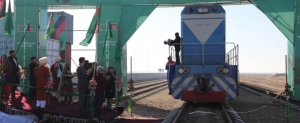
Since our last interaction, I am pleased to share with you significant progress and dialogues with our neighbors. The TAPI project will commence construction in Afghanistan in 2021. A $1.3 billion investment in a 500-megawatt transmission line from Turkmenistan to Pakistan through Afghanistan will complete its first phase in Herat next year. An Afghan private firm will invest in building our fiber optic lines with Turkmenistan and beyond.

We have also concluded a series of major agreements with Uzbekistan, including finalization of a 1,000 megawatt transmission line. With our central Asian neighbors, we are pursuing a plan to build railways that link us with Pakistan and India. The air corridor that started as an idea to get our fruits exported during a shutdown of our borders a few years ago is now connecting us to over 50 foreign export markets. The Port of Chabahar is now fully utilized for Afghanistan’s imports and exports as marked by the delivery of over 40K tons of Indian wheat assistance coming through Zarang.  We have also commenced a dialogue with Pakistan on trade, transit and people to people contacts.  We are ready to resume our historical function as an Asian Roundabout, serving as a platform of regional and global cooperation and peaceful transactions.

But amongst all of the problems we face, and of all of the development sectors we are juggling, the number one cause of suffering and depravation is imposed by war. Hence we come back to the ultimate goal of building an environment in Afghanistan that can actually sustain peace.

Peace building requires both state capacity and credibility, and market capacity and functionality. Without reasonable progress toward improving the effectiveness of the state and growing a functioning market, any peace agreement resulting from the negotiations runs the risk of becoming an empty promise.

Pulling these three pillars into a series of actionable plans that produce results is the challenge. But we have learned over the past five years that inter-ministerial National Priority Programs are an effective method of doing that.

Thus, we appreciate your commentary on the NPPs and the different sectors. I want to touch here on a few of the NPP sectors that we are going to be heavily focused on in the coming years.

First, the pandemic forced healthcare reform and improved delivery of health services to the forefront of our national agenda. To deal with disruptions caused by COVID 19, we had to urgently re-prioritize and make hard trade-offs. We mobilized most of the resources from reallocation of existing commitments. Our response was not only short term, but medium and long term.

We thank all of our partners for supporting the World Bank supported National Meal Program that is providing relief to 4.5 million households, about 90% of the population of the country.

At the same time, we undertook a systematic review of the National Health program. The top three priorities are response to COVID and dealing with a possible second wave; hospitals reform and governance; and the delivery of services through 3rd party organizations (the Sehatmandi program).

We have also examined the scope and scale of operations of the Ministry of Rural Rehabilitation and Development and will be sharing proposals for prioritization of its functions and the scope of its activities.

Based on feedback from women across Afghanistan, we decided that the Ministry of Women’s Affairs cannot continue to just be a policy-making entity, but must have programmatic delivery mechanisms to give practical support that helps further empower women as the economic, political and social change-makers that they are.

Infrastructure is a critical sector to our market-building pillar, yet it has been hampered by of misallocation of resources, poor management of programs and projects, and a lack of national integration and balanced development approaches. We will be paying particular attention to this sector and addressing these problems.

Another main focus over the next few months is on district-level governance. We have been working on a program to align security, governance and people’s participation at the district level, which has emerged as the crucial level of governance connecting the villages. Our national Citizen’s Charter program, which I should mention has 50% female council members, has empowered the village-level in decision-making processes, while also connecting them to municipalities, provincial and national level organizations. We now must focus with the same intensity on the districts.

Last but not least, we are focused on key sectors that will drive growth and enable us to enhance national revenue. 

The NPPs are our implementation vehicles, but we do agree that 15 of them cannot be effectively managed simultaneously. We must come together to do some intensive prioritization. Every NPP must become cross-ministerial and national in scope, and have clear goals for delivery in all 34 provinces.

Underlying and cross-cutting everything I have laid out today is our commitment to fighting corruption.

We are continuing to take systematic, comprehensive and sustained action again corruption, with strong public backing for these initiatives. Perhaps more-so than any other sector or issue, we have learned a great deal over the past 5 years about how corruption manifests in Afghanistan. Perhaps we have learned more than we anticipated we would be able to achieve, as we had planned for in our anti-corruption strategy.

While a significant amount of work has been done in recent months on developing key components of a national accountability system, we need a newly revised strategy for combatting corruption. This new strategy must be carefully informed by all the lessons learned, and focused more on producing results and setting goals that are achievable given the realities. We look forward to working with the EU and other partners to develop and implement a game changing approach. 

Today, I have tried to elaborate and give further clarity on our conceptual framework of peace-building, state-building and market-building and how they are intertwined. I have tried to give some insight on the lessons we have learned over the past five years, and the current context, which led us to this new framework. And I have tried to hone in on some of our key areas of focus as we move forward in implementation of our national priority programs.

But there is much more work for us to do. We have to do more information and knowledge-sharing; more rigorous and ruthless prioritizing of our NPPs; and really come together, not only around this conceptual framework, but also on the new rules of the game for implementing this new ANDPF II.

We are committed to do this in partnership with you.

Thus, we welcome your idea of a workshop, and in fact, we would like to expand that to propose five separate workshops held over the next two to three weeks that allow us to dig deep into the following issues:

  1. Peace-building, market-building, and state-building
  2. A strategic, long-term approach to peace-building
  3. Lessons-learned
  4. Regional connectivity and;
  5. Anti-corruption
  6. We look forward to planning these workshops with you.

I want to thank you once again for your partnership and your commitment. In preparing of this critical conference, I feel we have grasped an opportunity for meaningful and productive dialogue around Afghanistan’s future.

I hope that this dialogue and preparation can lead to the following outcomes of the conference:

  1. Achieving an understanding and plan for peace-building, and
  2. Achieving an understanding of past lessons learned and new goals for moving forward

More specifically, the conference will be an opportunity to signal to the Afghan people the international community’s continued partnership with Afghanistan. A practical step such as committing continued financial support to the key Trust Funds – Afghanistan Reconstruction Trust Fund (ARTF), the Law and Order Trust Fund Afghanistan (LOTFA), the Infrastructure Trust Fund – is one of the most important outcomes that will reinforce confidence in our international partnerships.

I also hope that we can reach an agreement regarding on-budget support and alignment, which is so important to building a system of national accountability and predictability.

We hope also to secure support for a number of prioritized NPPs, and overall support for women and youth empowerment programs. Aside from the NPPs, we would like a realistic market-building strategy to be an outcome of the conference, one that is backed up by risk guarantees and insurance for trade, investment, and regional connectivity.

In closing, I come back to peace, which is not only the dominant theme of our national discourse, but the dominant theme of our development strategy.

Our people have reached an exceptional balance between realism and pragmatism. We want to overcome the pain and agony of the last 40 years but we also know that this cannot be achieved in a matter of days.

Making the type of peace that will have public support, and making it within the framework of the Constitution, will ensure order. Having experienced displacement, our people have no intention of allowing the repetition of the past.

I hope that, above all, we can consolidate our partnership to realize these noble aspirations and dreams.

We are meeting to vision, dream, plan and deliver on a future for all Afghans. The shadow of violence, however, is haunting our people. Your support for an immediate, comprehensive ceasefire is essential.

Given what the Afghan government and people have done through our historic Loya Jirga to make the talks possible, there is no reason to engage in the type of scale and scope of violence that is hurting our people.

Your unified voice in condemning violence and asking for a ceasefire will ensure that a political solution to the conflict will be found and will be sustained.

Thank you.


Ottawa- October 2, 2020

During a virtual meeting on October 02, 2020 with Director General David Hartman of the South Asia Bureau, and Mr. Christopher Gibbins, the new Executive Director for Afghanistan & Pakistan, Global Affairs Canada, Ambassador Soroosh offered his sincere congratulations and best wishes to Mr. Gibbins as he assumes this new position.
 
Ambassador Soroosh also extended his gratitude to Ms. Diane Harper, the former Executive Director for Afghanistan and Pakistan for all her excellent efforts in facilitating multifaceted cooperation between the two countries.
 
Various areas of bilateral cooperation, the peace process and the upcoming Geneva Conference on Afghanistan were also discussed during this virtual meeting.

Ottawa- September 30, 2020

Ambassador Hassan Soroosh had a phone conversation with H.E. Kerim Uras, Ambassador of the Republic of Turkey in Ottawa. They discussed various areas of bilateral cooperation, the ongoing Afghanistan peace negotiations as well as future potential collaboration between Afghanistan, Turkey and Canada.
 
Ambassador Soroosh expressed his appreciation for Turkey’s continued commitment and support to Afghanistan and the Afghan peace process.

Ottawa- September 29, 2020

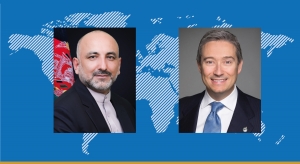
H.E. Mohammad Haneef Atmar, Acting Minister of Foreign Affairs of the Islamic Republic of Afghanistan and H.E. Francois-Philippe Champagne, Minister of Foreign Affairs of Canada held a phone conversation this morning. The two sides discussed various aspects of bilateral cooperation; the Afghan peace process; the upcoming Geneva Conference on Afghanistan as well as the ongoing efforts under the International Coordination and Response Group for victims of Flight PS752. Sharing their concerns over the recent increase in violence in Afghanistan, both sides stressed the importance of serious commitment to ceasefire. They further highlighted the importance of preserving the gains of the past 19 years in Afghanistan as well as the significance of continued collective efforts to further consolidate these gains.
 
H.E. Acting Foreign Minister Atmar extended his gratitude for Canada’s continued friendship, solidarity and partnership with the people and government of Afghanistan.

Ottawa- September 24, 2020

Ambassador Hassan Soroosh had a phone conversation with H.E. Sabine Sparwasser, Ambassador of the Federal Republic of Germany to Canada. The two sides discussed the COVID-19 situation, multifaceted bilateral cooperation, the Afghan peace process as well as future collaboration between the two missions.
 
Ambassador Soroosh expressed his gratefulness for Germany’s principled position and unwavering commitment in support of Afghanistan and the Afghan peace process.

Ottawa- September 23, 2010


Bismillah Rahman-ur-Rahim.

Mr. Chairman, Ladies and Gentlemen,

We, the people of the United Nations, this year observe our 75th anniversary. We do so at a time of unprecedented global turmoil. 

All of us here today share a common ccondition, a condition that does not distinguish between developed or developing countries. This turmoil that defines our times is a global phenomenon. And while all of us bear a share of the burden of this turmoil, some countries bear a much larger share than others.  

***

Afghanistan is one such country. We find ourselves simultaneously at the center of regional opportunity, and also at the center of the manifestation of global problems.

Afghanistan is positioned right at the heart of Asia. Our water ties us together; our cultures and languages give us a common denominator; South Asia’s need for energy resources and Central Asia’s abundance of it makes Afghanistan a critical connector. Asia cannot integrate without us. We are right at the heart of untapped potentials that could bring prosperity and peace to our region. 

But this means that we are also right in the middle of the turmoil that is affecting us all today. We are experiencing the worst of it. But Afghanistan could be a model for successfully overcoming the turmoil we all face. That task, like the turmoil, is one that belongs to all of us. 

***

We must first identify the drivers of this turmoil. There are five sources, all of which Afghanistan has been dealing with simultaneously. 

The COVID-19 pandemic exposed our vulnerabilities, to the point that we as a global community could no longer afford to ignore them. We Afghans were fortunate to have contained the first wave of the pandemic through close government, business and societal cooperation, with minimal input from the UN agency, but the pandemic has exposed gaps in our systems that must be addressed.

The COVID-19 pandemic has done for us what World War II did for generation before us—both had such immense human costs and were phenomenon that had such a global impact that then, and now, we are forced to pay attention and take unprecedented action. 

***

In the face of vulnerabilities exacerbated by the pandemic, another driver of inequality and unemployment is upending our world—the 4th industrial revolution. The digital age is upon us, challenging us to adapt the ways we consume, the ways we work, and the ways we govern. 

In Afghanistan, we are experimenting with how to adapt so that this digital revolution can be wielded as a source of economic opportunity for our overwhelmingly young population, as well as a way to strengthen our systems of governance and rule of law. We are looking far ahead with the knowledge that if we try to replicate 19th or 20th century models now, they will become irrelevant as soon as we stabilize them. The same can be said for global attempts to harness the drive of the 4th industrial revolution—we have to think ahead of our time. 

This new kind of industrial revolution, combined with the pandemic, presented challenges in planning and executing this very gathering, and yet the UNGA leadership has managed to creatively transform this experience into one that is more efficient, effective, convenient and far less risky. I want to congratulate His Excellency Volkan Bozkir not only on assuming the Presidency of this 75nd Session of the UNGA, but also for his success in overcoming the particular challenge of hosting a massive gathering of global leaders during the pandemic.

***

Violence and warfare have also evolved, an evolution we Afghans have witnessed and suffered in real time. We are living, and dying, inside the 5th wave of global terrorism, in which global terrorist networks are closely linked with global criminal networks, making warfare totally unconventional and peace-building even more of a challenge. 

As a state and society, we have demonstrated the commitment, compassion and courage to take hard decisions to start direct peace talks with the Taliban.  This won’t be enough. For sustainable in Afghanistan, we must get to the root of the terrorism problem blighting our region and address it as the global phenomenon, and threat, that it is.

The untold sorrow of the Afghan people, particularly our women and children, during the last 40 years, serves as a reminder of the relevance of the UN Charter, and also of its unfulfilled promise, of “maintaining international peace and security.”  

***

Climate change has effected another type of violence and suffering on our people. Afghanistan is the 17th worst affected country in the world. 

Just last month, hundreds of Afghans were killed or injured, and had their entire homes and livelihoods destroyed, when massive flood waters ripped through the province of Parwan. Two years before, the other extreme—drought—led us to nation-wide wheat shortages and upended the livelihoods of the majority of our population who rely on jobs in agriculture to put food on their tables. 

Drought and floods are seasonal occurrences for Afghanistan. We need regional solutions based on international models to address the problem of climate change. 

We have signed memorandum of understanding with the Fortescue Metals Group to form Afghanistan into a leading green industry, energy and intend to produce 20,000 megawatt from hydro and use it to produce zero emissions steal and other products from an estimated 1 trillion $ mineral resources.

We are also in discussion with other corporations to turn 70,000 megawatt of wind, and 220,000 megawatts of solar into renewable energy, thereby become a hub for renewable energy and green industry in the region.

***

The fifth driver of turmoil is a culmination of the first four—an unprecedented explosion of inequality that will continue to perpetuate this state of turmoil, until—or unless—we take action. In Afghanistan we are focusing on human capital and human security to create the equality of opportunities for our fellow citizen and societal stability for our people. 

I come back now to the first driver — the COVID-19 pandemic— because the scope and scale of its impact forced us to see the other four drivers, which were worsened and highlighted by the pandemic. 

The pandemic taught us an urgent lesson: We can no longer ignore these drivers. 

***

The cost of our inaction is uncertainty. 

We are asking ourselves at this General Assembly what kind of future do we want to live in? 

In truth, the extreme levels of uncertainty make the future very difficult to predict, but if I were to try and address that question my answer would be simple.

We have to get back to basics.  We have to go back to the foundational values of the United Nations and the documents that enshrine them—the UN Charter and the Universal Declaration of Human Rights—and we have to fulfill those yet-unfulfilled promises.

The future must hold, to quote the preamble of the Universal Declaration of Human Rights, “recognition of the inherent dignity and of the equal and inalienable rights of all members of the human family,” which is truly the “foundation of freedom, justice and peace in the world.”    

***

These values have been embraced the world over. The Universal Declaration of Human Rights is today universal discourse. Its values have been reflected in almost all state constitutions since the demise of the Soviet Union. 

But these values have not been actualized.

These should not be lofty ideals and aspirations of the international community. They should be achievable goals. In Afghanistan, they are urgent and real problems we grapple with daily.

***

What will it take to fulfill these promises of peace, prosperity, dignity, justice, and freedom?

To shape our shared future in a direction that will fulfill these promises for all of us will take unprecedented acts of cooperative and coordinated actions at all levels of the global village’s community, economy and governance. 

We need frameworks for the future that present pragmatic solutions for collectively addressing and solving the five drivers of turmoil, particularly global terrorism and climate change. 

This will require the type of imagination and leadership that gave us the Universal Declaration of Human Rights, the UN Charter and the capabilities that overcame the global turmoil inflicted on the world by World War II.

***

With these frameworks in place, we can get back to the foundational basics that the United Nations was created to address in the first place.

The United Nations that we need is an organization with the authorities, capabilities, capitals, and commitments to fulfill the purposes and principles of this Charter.

I would like to commend His Excellency Secretary General Guterres for the progress made so far in his reform agenda for the UN. But we have much further to go, and we all have a shared responsibility to shoulder in efforts to progress the sustainable development goals and progress peace, prosperity and security across the globe.

***

In Afghanistan, we are moving into the next five years with a clear plan for progressing the values of the UN, which are enshrined in our constitution, and working toward prosperity, security and peace in our own country.

Our plan is based on building our markets for economic development, moving from an aid to a trade model, increasing our labor and capital productivity in key areas in which we have a competitive advantage. 

The objective is self-reliance, moving away from donor relationships to mutually beneficial partnerships.

At the same time, we will invest in strengthening state governance structures to create an environment conducive to growth. This means continuing to combat systemic corruption, improving our public financial management systems, and strengthen provincial and district level governance.

We are looking closely at the gaps and weaknesses exposed by the pandemic, and strengthening our systems for the long-term. 

***

Though we are facing multiple drivers of turmoil all at once in Afghanistan, above all, peace remains our most urgent and important priority. 

There is a passage from the UN Declaration of Human Rights that encapsulates our current goals for peace in Afghanistan: we want “to save succeeding generations from the scourge of war, which twice in our lifetime has brought untold sorrow to mankind, to unite our strength, to maintain international peace and security.”

The role of the United Nations in standing for our shared values throughout the peace process is absolutely critical, and we thank the United Nations for their support so far throughout this arduous process. we thank the UN for their call for a global ceasefire and

The role of the UN and our international partners and allies will continue to be extremely important as our negotiating team sits across from the Taliban in Doha.

At those talks, the Afghan people have a clear and urgent priority: a ceasefire. An urgent end to the violence will, more than anything else, give us a chance to progress. 

I would like to take this opportunity to call on every member of the General Assembly and the P-5 to help us achieve the end-state of a sovereign, united and democratic Afghanistan, at peace with itself and the region, capable of preserving and expanding the gains of the last 19 years.  A democratically stable and prosperous Afghanistan will be an example of how our collective will can overcome the turmoil and uncertainty that defines our world today.  

Thank You

Ottawa- September 23, 2020
 
Ambassador Hassan Soroosh had a virtual meeting this morning with H.E. Abdul Kadir Jailani, Ambassador of the Republic of Indonesia to Canada. The two sides discussed various aspects of bilateral cooperation, the Afghan peace process as well as potential areas of collaboration between Afghanistan, Indonesia and Canada in the future.
 
Ambassador Soroosh extended his gratitude for Indonesia’s continued commitment and active engagement in support of Afghanistan and the Afghan peace process.
Go to Top